Wrocław in one day
A morning on foot from the Market Square (Rynek) to Cathedral Island (Ostrów Tumski) and the Racławice Panorama, then an afternoon by tram at the Centennial Hall and the park around it. Each stop links to its own page.
Szczecinolog Wikimedia Commons CC BY-SA 4.0
Morning
Book the Panorama before you set out. It is seen in viewing sessions, and a ticket is for one session, on a set date and at a set time, so choose one that leaves room for the square and the island first.
Market Square
The centre of the medieval town, laid out after 1241 as the middle of a regular grid; the buildings around it were damaged in 1945 and rebuilt afterwards. The main tourist information centre is on the square, at Rynek 14.
Town Hall
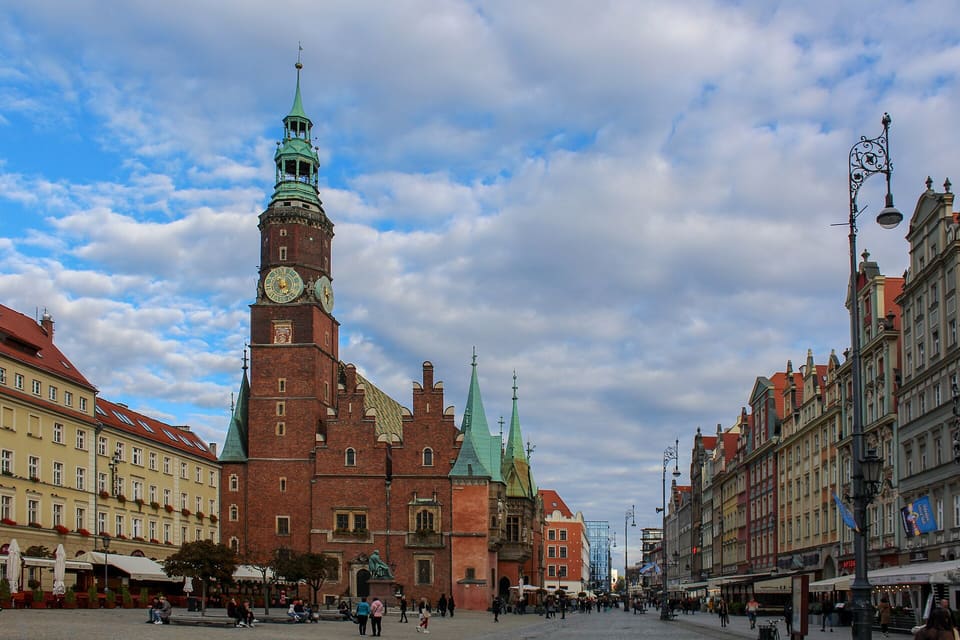
The Old Town Hall in the middle of the square: the seat of Wrocław's city council and courts, built in stages from the end of the 13th century into the 16th, now home to the Museum of Bourgeois Art.
From the Town Hall to Tumski Bridge is about 1.2 kilometres, about 15 minutes' walk, north to the river and across Piasek Island. The river, its islands and its bridges are described on Islands & bridges.
Tumski Bridge
The steel bridge of 1889 between Piasek Island and Cathedral Island, once hung with couples' padlocks, which are now forbidden. On the far side the cathedral's towers are ahead of you, about 5 minutes' walk.
Cathedral
The Gothic Archcathedral of St John the Baptist on Cathedral Island, badly damaged in 1945 and rebuilt in the years after. A lift in one of its towers carries visitors up to a viewing terrace.
From the cathedral to the Panorama is about a kilometre, about 10 minutes' walk, south over the Odra.
Racławice Panorama
A painting 15 by 114 metres, made by Jan Styka and Wojciech Kossak for the centenary of the Kościuszko Uprising, shown in Lwów in 1894 and in Wrocław since 1985, in its rotunda at Jana Ewangelisty Purkyniego 11.
Keep the ticket. The Panorama, the National Museum, the Four Domes Pavilion and the Ethnographic Museum are one institution, and a ticket bought for the Panorama admits you free to the permanent exhibitions of the other three for three months from the day you see it — the Four Domes Pavilion is on this afternoon's route.
Afternoon
From the Panorama, walk back to Świdnicka Street, to the tram stop where it crosses Kazimierza Wielkiego — about 1.3 kilometres, about 15 minutes. Take tram 10 or 19 east for 3.5 kilometres and get off at ZOO. The Centennial Hall is close by, and its page shows the ride from the Market Square on a map.
Fallaner Wikimedia Commons CC BY-SA 4.0
Iglica
The steel spire in the square in front of the Centennial Hall, designed by Stanisław Hempel and built in 1948 for the Recovered Territories Exhibition.
Centennial Hall
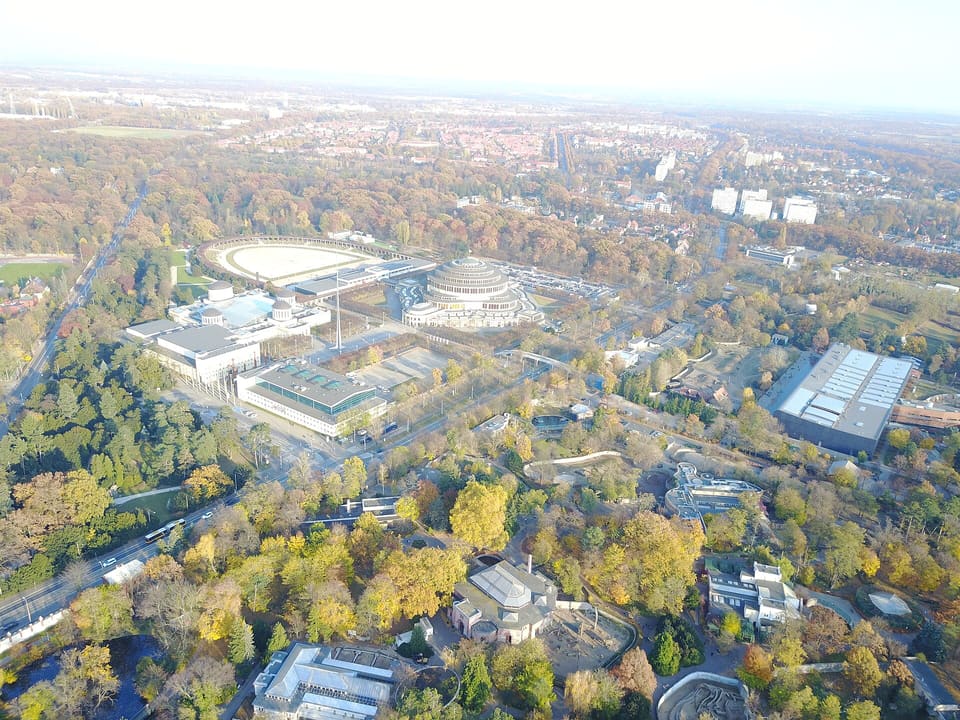
A reinforced-concrete hall under a ribbed dome 65 metres across, designed by Max Berg, built in 1911–1913 and on the UNESCO World Heritage List since 2006. It stands in the Exhibition Grounds, with the Four Domes Pavilion and a pergola.
Four Domes Pavilion
Built beside the hall in 1912 and 1913 to Hans Poelzig's design, a film studio from 1953, and since 2016 the National Museum's museum of contemporary art — the one this morning's Panorama ticket lets you into.
The Pergola and the Multimedia Fountain
A show of water, music and lighting at the Pergola, next to the Centennial Hall, opened on 4 June 2009.
Japanese Garden
In the southern part of Szczytnicki Park, near the Pergola: laid out in 1913 for the Centennial Exhibition and reopened in 1999 after restoration. It opens for a season, from April to the end of October, and is closed through the winter.
Szczytnicki Park
The park around the hall, the pavilion, the fountain and the garden: more than 100 hectares, begun in 1783 as a prince's garden, with the wooden church of St John of Nepomuk, brought here in 1913 for the Centennial Exhibition.
Evening
Stay for the fountain. It runs in a season, and its shows on the hour carry on into the evening, when lighting is added to the water and the music. More for after dark is on Wrocław at night.
Between the stops
For food, see What to eat in Wrocław. For trams, buses and other ways of moving around, see Getting around. With more time, this morning is day one of Wrocław in three days, and the afternoon is half of its day two.