Market Square
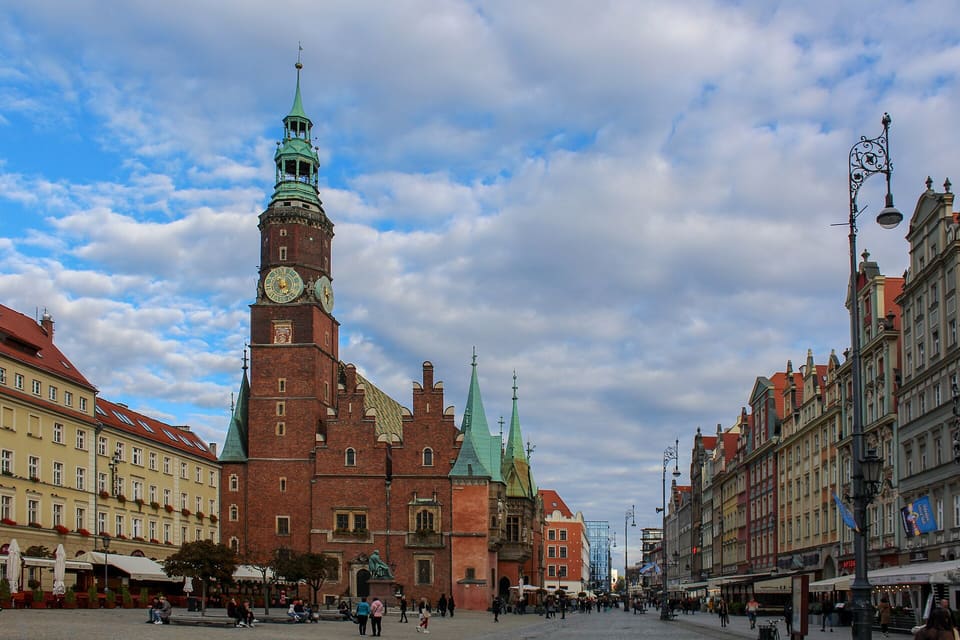
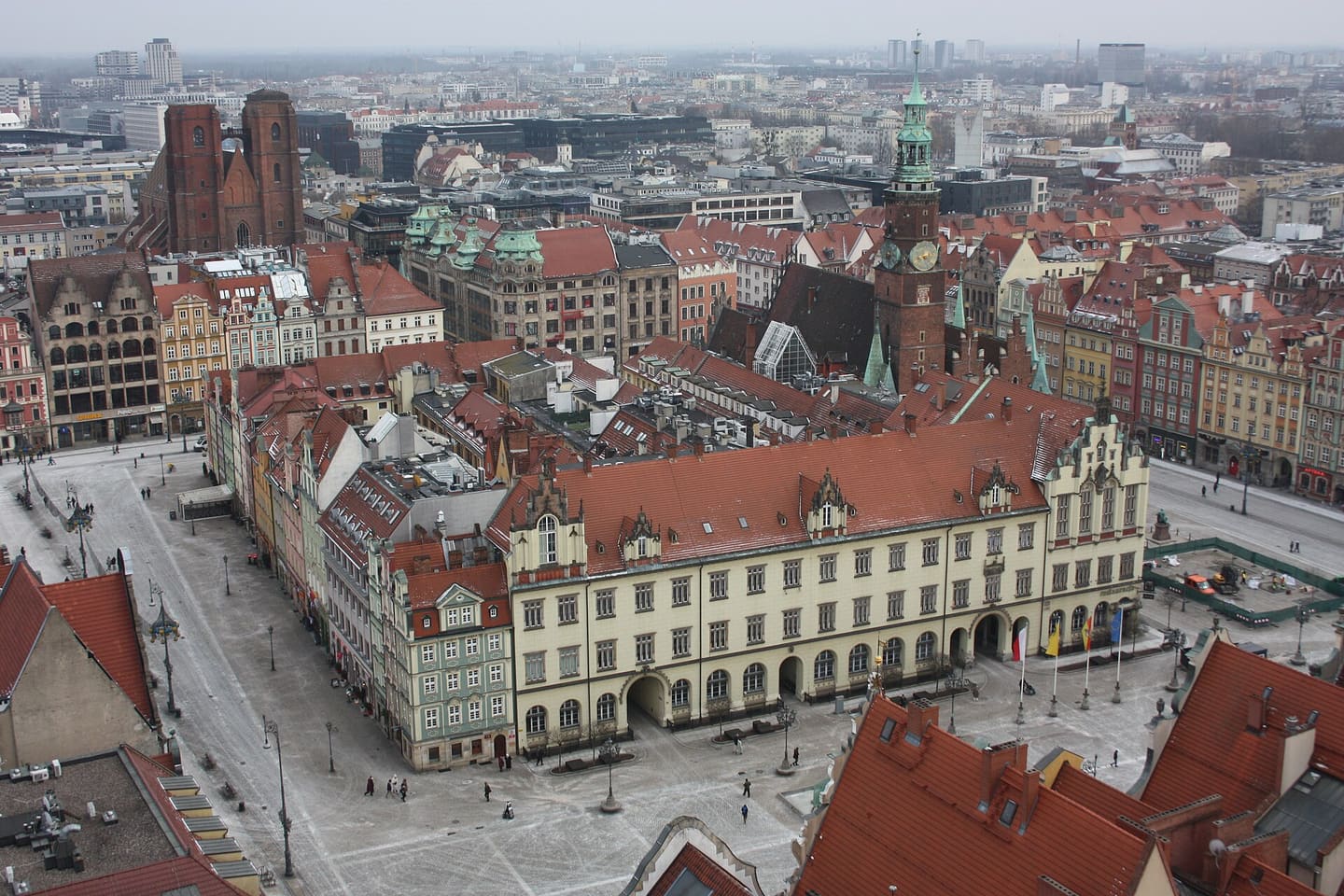
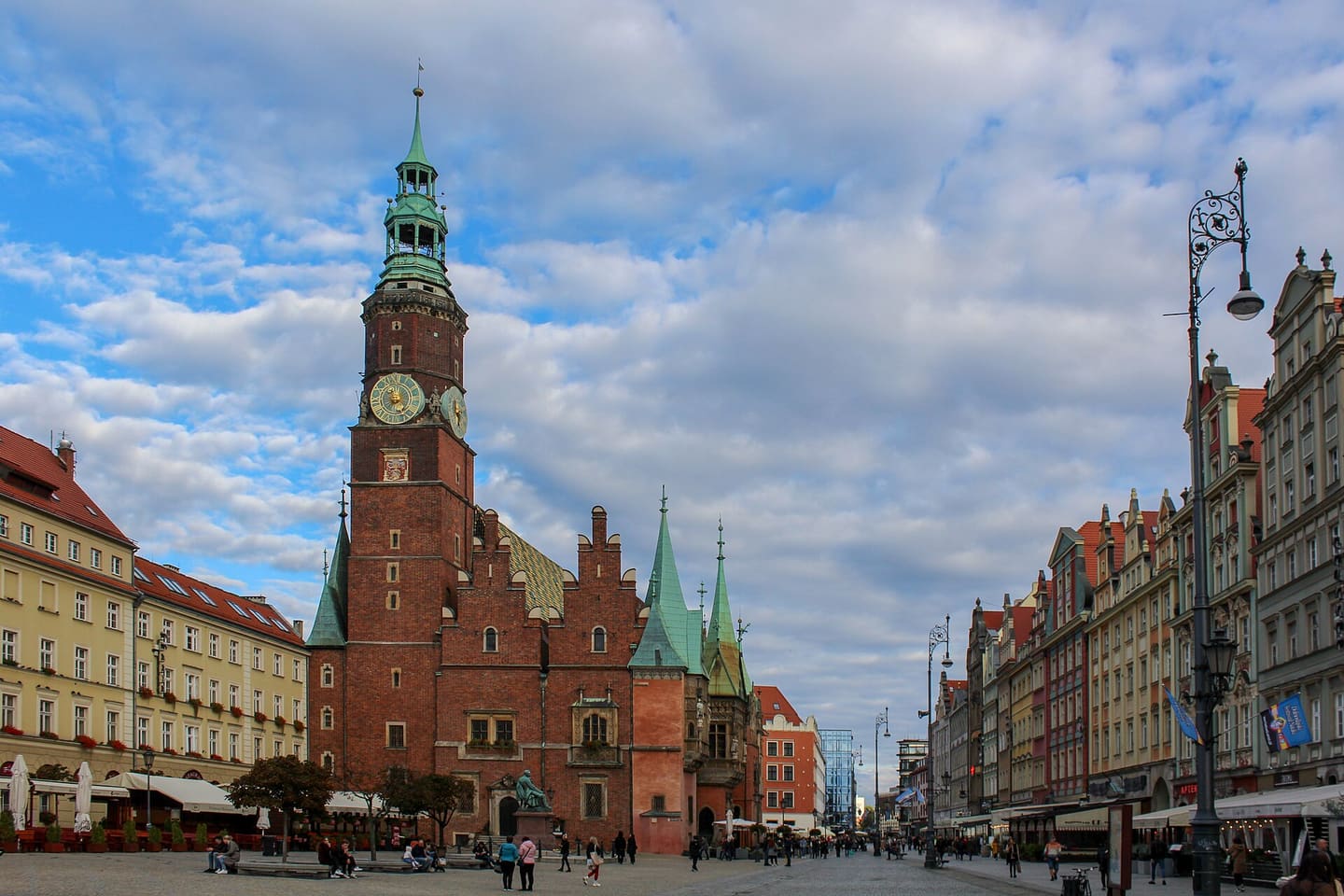
The Rynek: Wrocław's Market Square, laid out after 1241, rebuilt after 1945, with the Town Hall in the middle.
Szczecinolog Wikimedia Commons CC BY-SA 4.0
What it is
The Market Square is the centre of the medieval town. It was laid out after the destruction of 1241 as the middle of a regular grid.
The Town Hall does not stand on the edge but in the middle, among a block of other buildings, with the houses of the burghers around the outside.
The houses
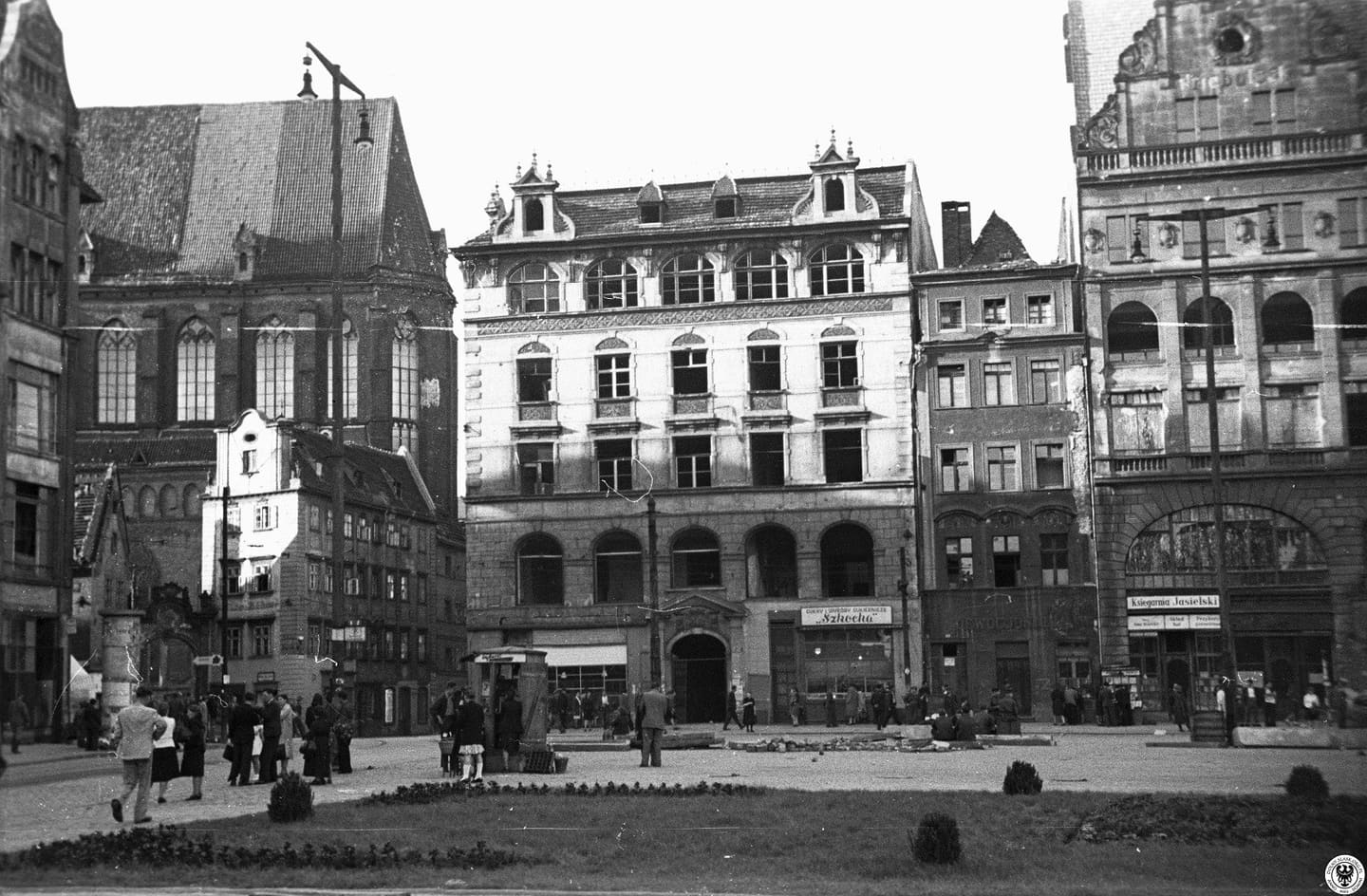
Rebuilt after 1945.
The buildings around the square were damaged in 1945 and rebuilt afterwards.
On the square
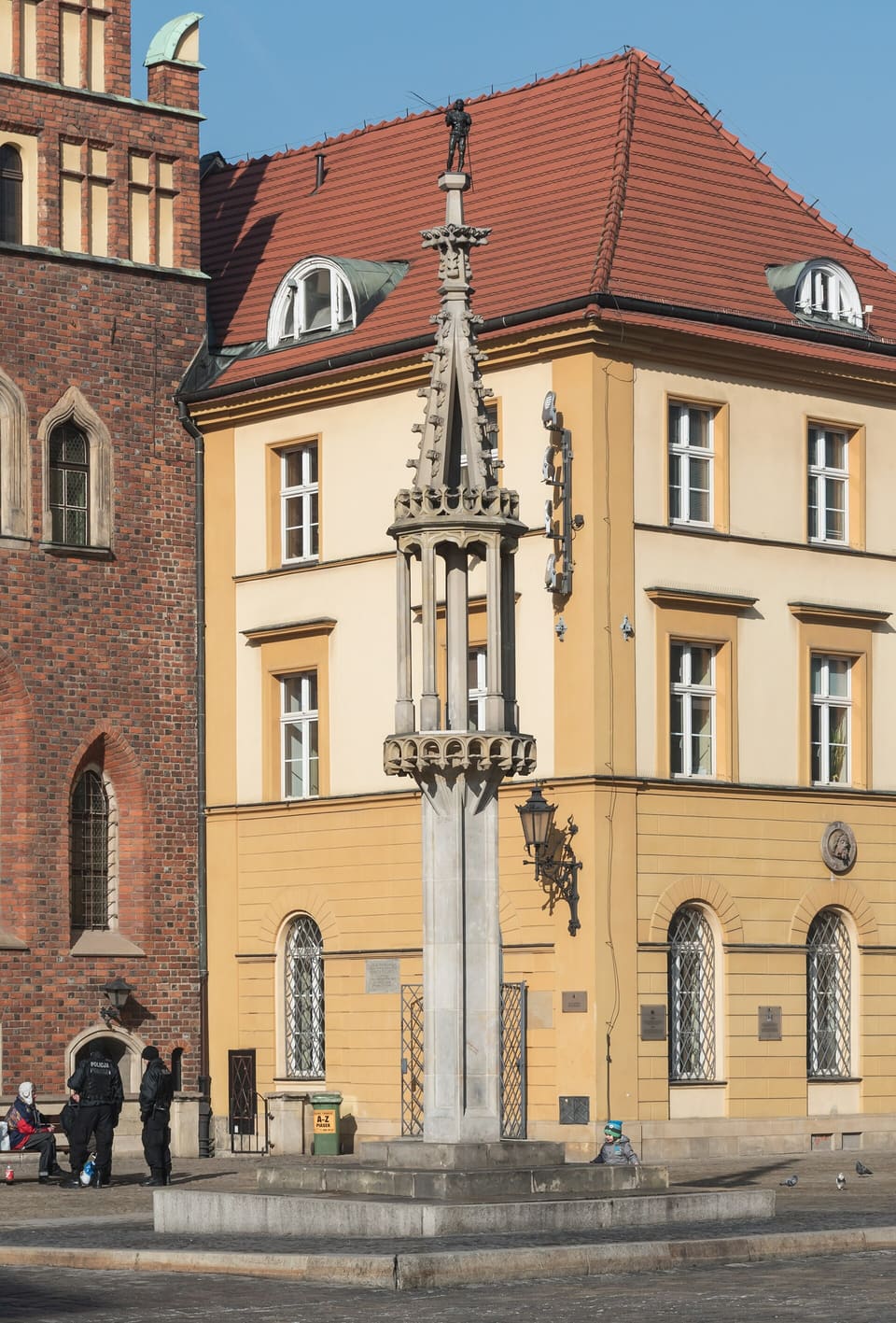
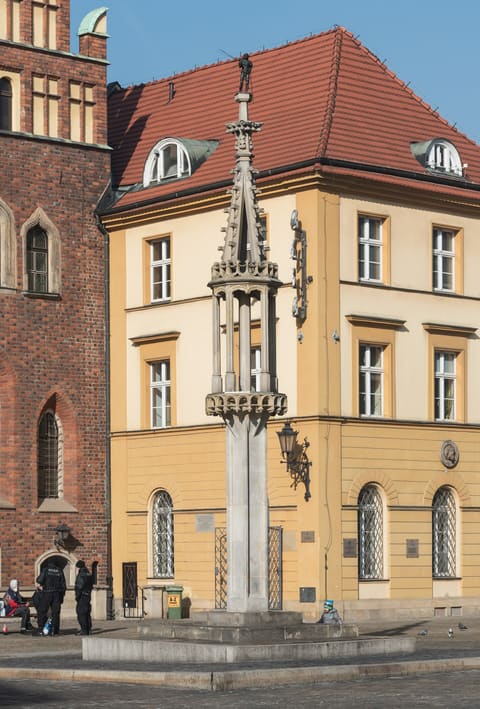
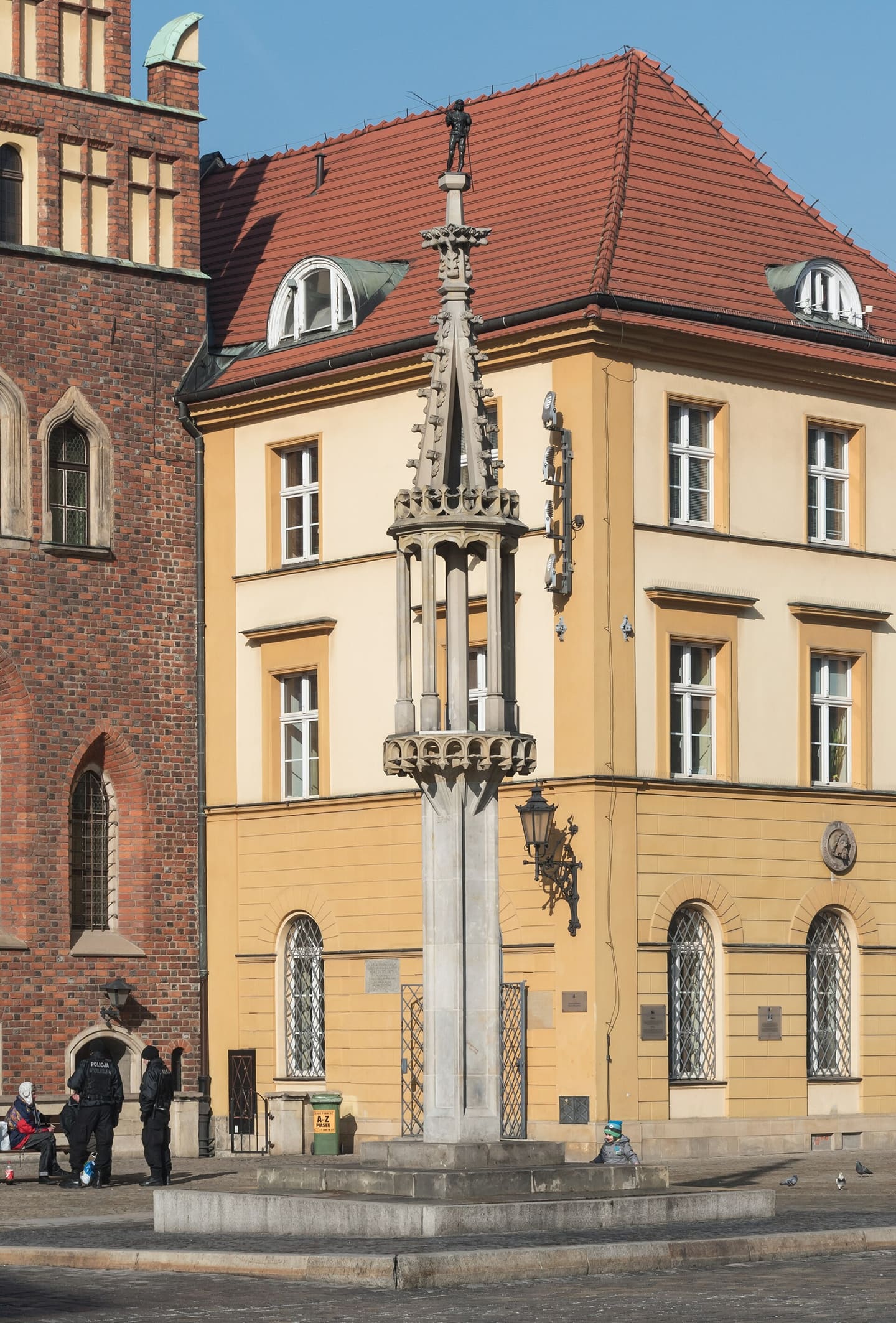
The pillory. The pręgierz is a post to which convicted people were tied. The one by the Town Hall was put up in 1492, in place of an earlier pillory of wood, and the original was topped by a figure of an executioner holding a sword and a bundle of rods, called Roland. It was destroyed in 1945; what stands there now is a copy, set up in 1985. Wrocławians use it as a place to meet.
Jacek Halicki Wikimedia Commons CC BY-SA 4.0
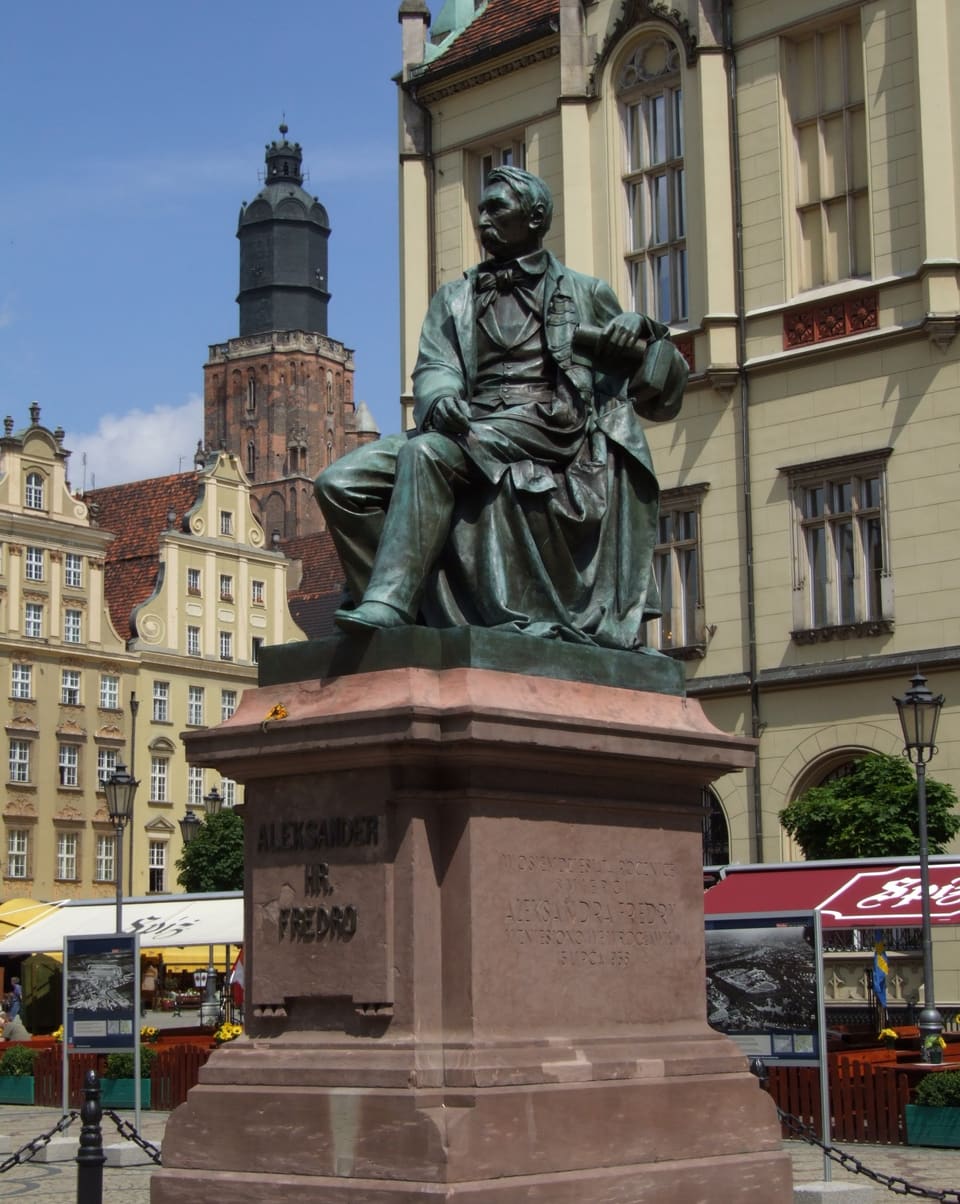
The Fredro monument. Leonard Marconi's bronze of the playwright Aleksander Fredro was made for Akademicki Square in Lwów and unveiled there in 1897. It shows him seated, a pen in his right hand. After the war it came to Wrocław, as the Panorama did: dismantled in Lwów, held for a time at Wilanów outside Warsaw, delivered to the square on 27 April 1956 and unveiled on 15 July that year, the eightieth anniversary of Fredro's death.
It stands on the southern side of the square, in front of the Town Hall, on the spot where an equestrian monument to Friedrich Wilhelm III of Prussia stood until it was taken down just after the war.
The pen does not stay in his hand. The city replaces it, on average, more than a dozen times a year; the replacement is a resin replica and costs about 600 złotys to make and fit.
Pudelek Wikimedia Commons CC BY-SA 4.0
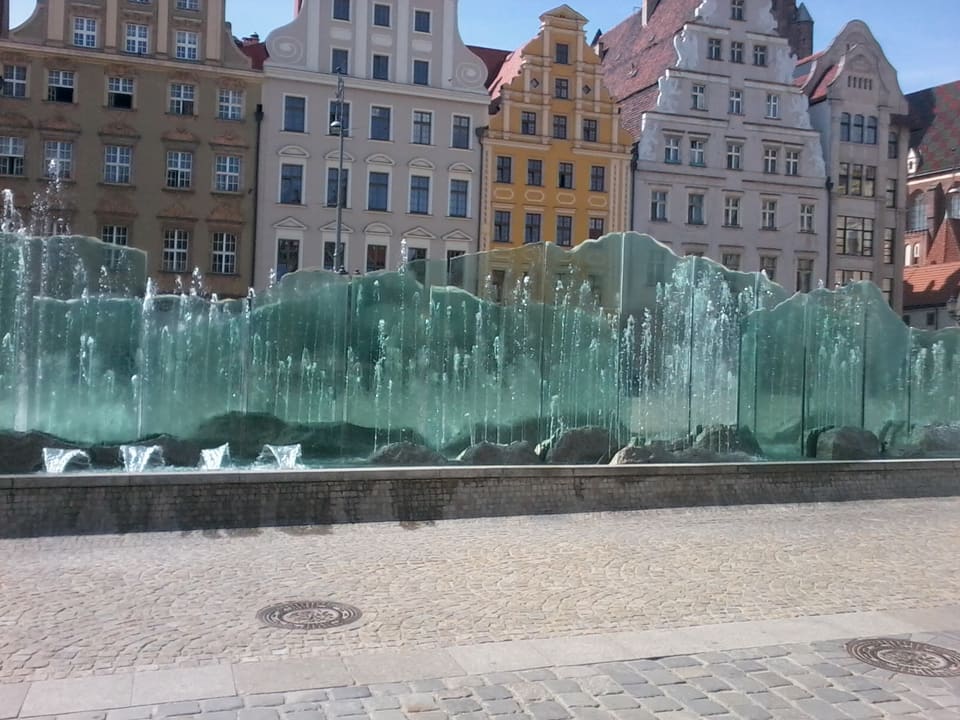
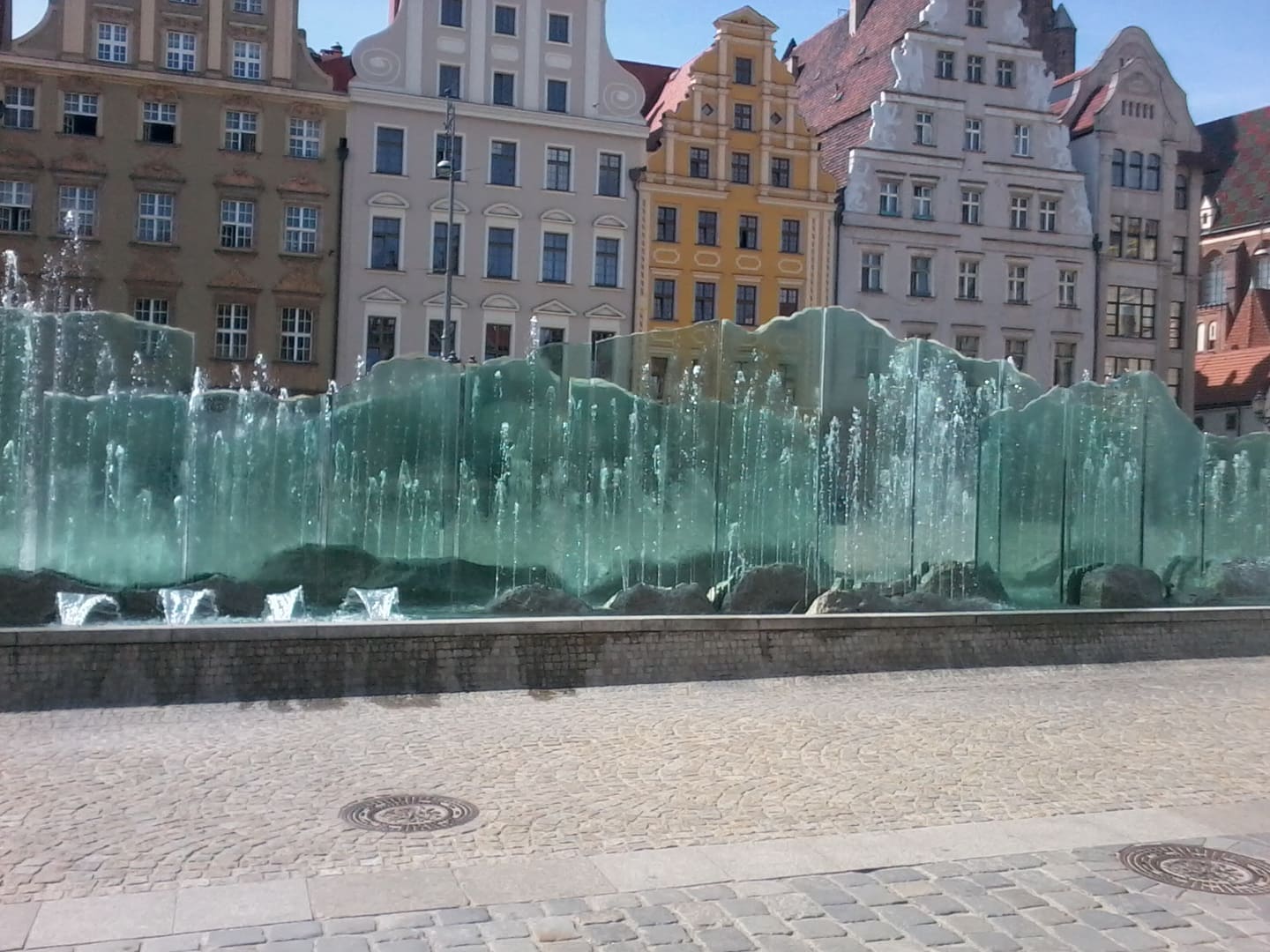
The Zdrój fountain. A fountain of glass panes stands on Gołębi Square, the western part of the Market Square. It was designed by the sculptor Alojzy Gryt and put up in 2001. Zdrój means a spring, and the name is also the city's joke on Bogdan Zdrojewski, its mayor when the fountain was built. More statues and fountains are on one page.
Adaś17 Wikimedia Commons CC BY-SA 3.0
The Grotowski Institute. At Rynek-Ratusz 27, behind the Town Hall, is the building Jerzy Grotowski's theatre made its home in January 1965. The Grotowski Institute, named after him, has its seat there now.
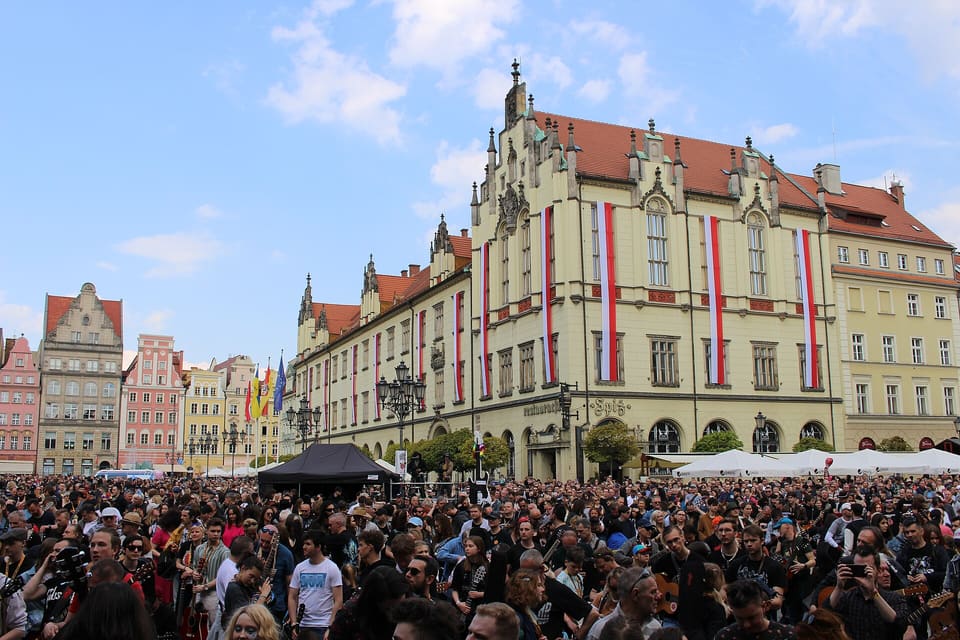
The guitar record. On 1 May the square fills with guitarists playing Jimi Hendrix's “Hey Joe” together. It started on 10 May 2003, when 588 of them turned up, and it is Leszek Cichoński's doing — he is still its artistic director. It is called the Gitarowy Rekord Świata now, the Guitar World Record, and the most who have ever played it is 8,122, in 2025. In 2026 7,649 came and the record stood.
The name used to say Guinness, and the change is worth a sentence. The figure Guinness World Records still holds for the largest guitar ensemble was set on this square on 1 May 2009, and it is 6,346 — the attempts have been bigger than the ratified record for years.
Nietoksyczny Wikimedia Commons CC BY-SA 4.0
On the map
The Town Hall in the middle of the Rynek, Plac Solny at the south-west corner, and Hansel and Gretel by St Elizabeth's at the north-west. Select a number for a note.
Map data © OpenStreetMap contributors, under the ODbL.
On the map
-
Kolossos, Wikimedia Commons, CC BY-SA 3.0 Town Hall
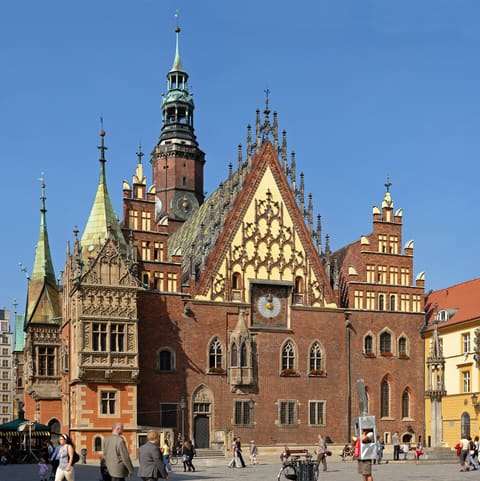
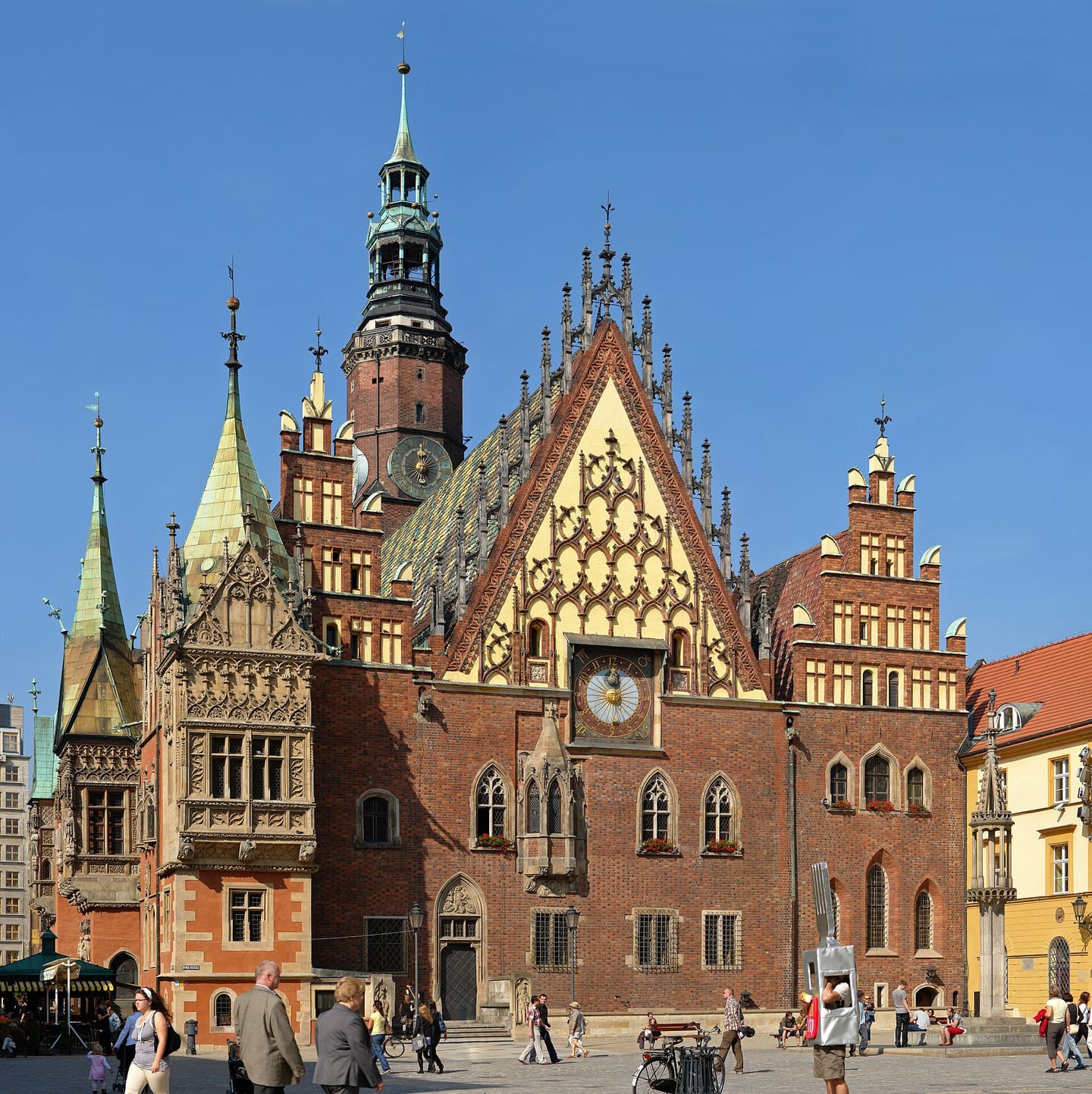
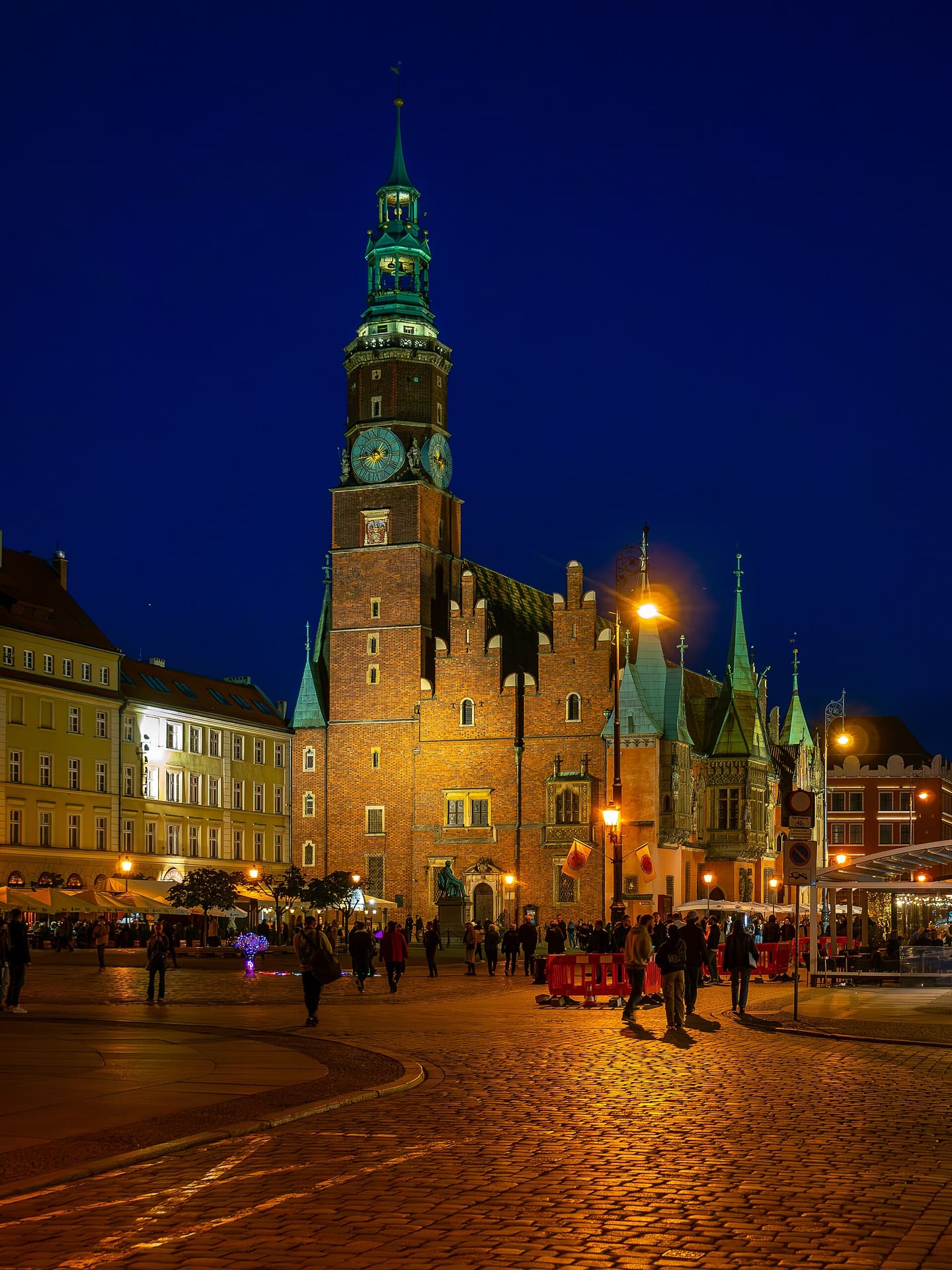
Ratusz, the Old Town Hall
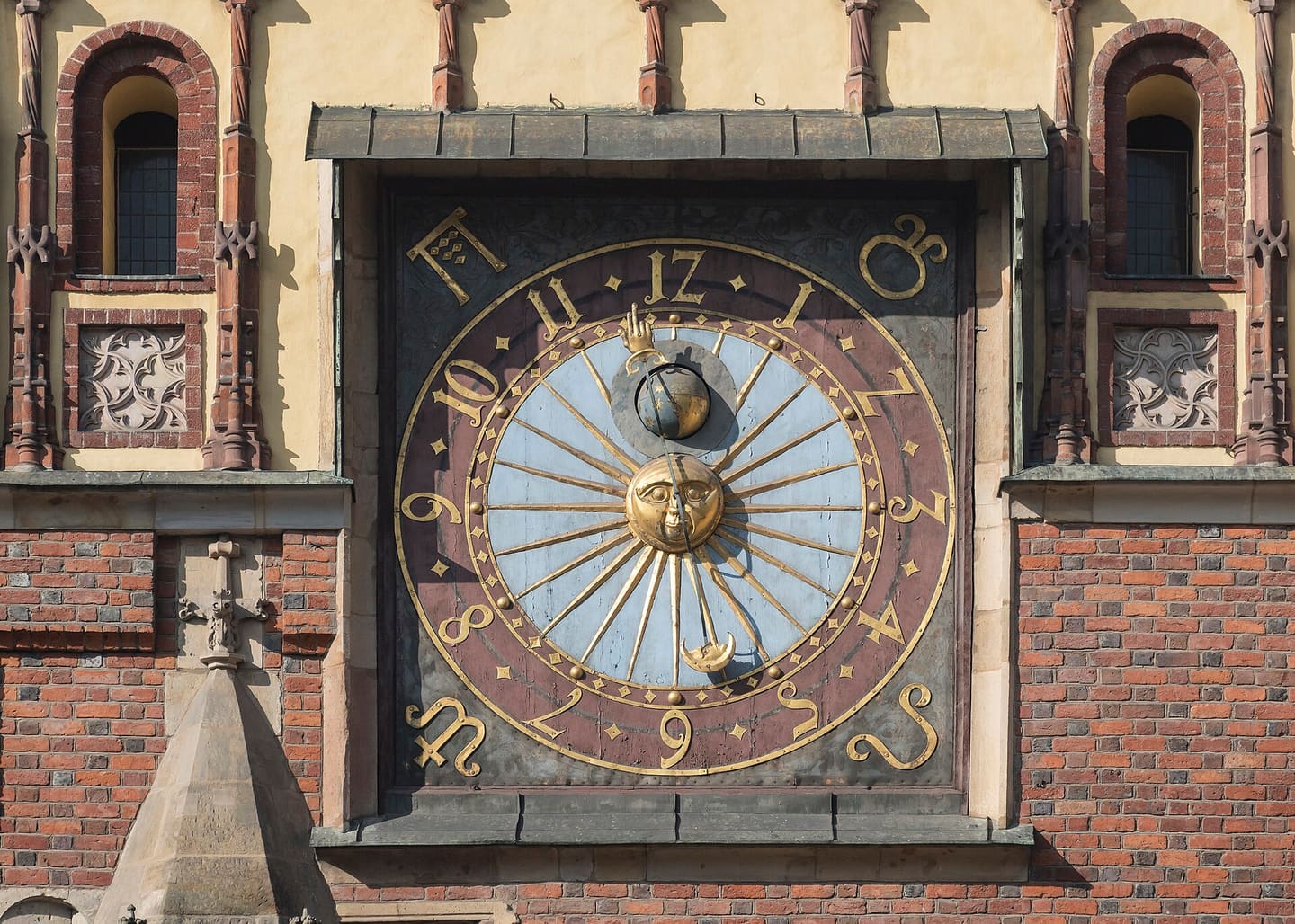
The seat of the city authorities and of the city’s courts, built in several stages over about 250 years, from the end of the 13th century into the 16th. The tower is 66 metres high. The clock on the east facade was set going in 1580.
Not pinned: the Great Hall, the Princes’ Hall and the Council Chamber, and the Piwnica Świdnicka, an inn in the cellars since the end of the 13th century.
-
Museum of Bourgeois Art
in the Town Hall
A branch of the Muzeum Miejskie Wrocławia (Wrocław City Museum) since 2000. It collects and shows objects connected with Wrocław craft workshops and artists, in the rooms the council used.
The Great Hall covers more than 650 square metres under a ribbed vault.
-
Jacek Halicki, Wikimedia Commons, CC BY-SA 4.0 The pillory
Pręgierz
A post to which convicted people were tied. The one by the Town Hall was put up in 1492, in place of an earlier pillory of wood. The original was destroyed in 1945; what stands there now is a copy, set up in 1985. Wrocławians use it as a place to meet.
-
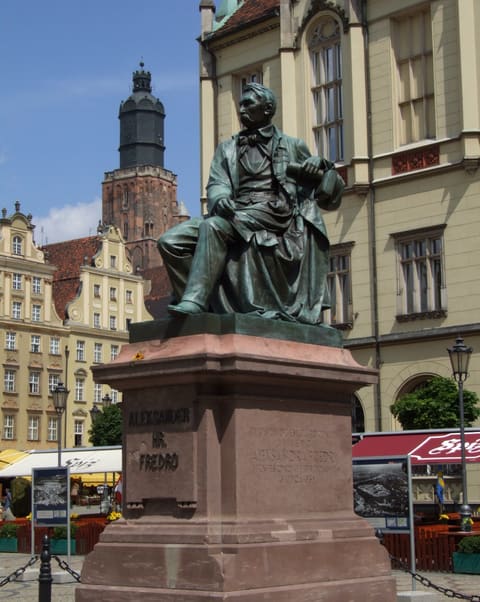
Pudelek, Wikimedia Commons, CC BY-SA 4.0 Fredro monument
Aleksander Fredro
Leonard Marconi’s bronze of the playwright Aleksander Fredro was made for a square in Lwów and unveiled there in 1897. It shows him seated, a pen in his right hand. It came to Wrocław after the war, and was unveiled on the Market Square on 15 July 1956. It stands on the southern side of the square, in front of the Town Hall.
The pen does not stay in his hand. The city replaces it, on average, more than a dozen times a year.
-
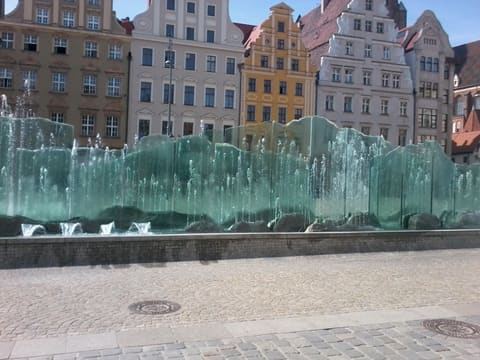
Adaś17, Wikimedia Commons, CC BY-SA 3.0 Zdrój fountain
plac Gołębi
A fountain of glass panes on Gołębi Square, the western part of the Market Square. It was designed by the sculptor Alojzy Gryt and put up in 2001. Zdrój means a spring, and the name is also the city’s joke on Bogdan Zdrojewski, its mayor when the fountain was built.
-
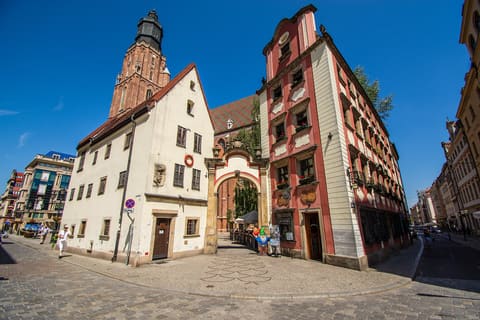
Jg44.89, Wikimedia Commons, CC BY-SA 4.0 Hansel and Gretel
Jaś and Małgosia
Jaś and Małgosia are the Polish names of Hansel and Gretel, and the names of two houses. Gretel is at 39/40 Odrzańska Street and is the seat of the Society of Friends of Wrocław.
On the wall of Hansel that faces St Elizabeth’s church is a sandstone panel by Eugeniusz Get-Stankiewicz, walled in in May 1997. Its brass strip reads ZRÓB TO SAM · DO IT YOURSELF.
-
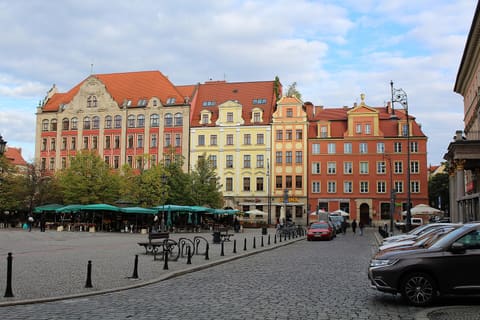
Szczecinolog, Wikimedia Commons, CC BY-SA 4.0 Salt Square
Plac Solny
Plac Solny is Salt Square in Polish. It lies beside the Market Square. Electric tour cars generally wait for tourists on the square.
-
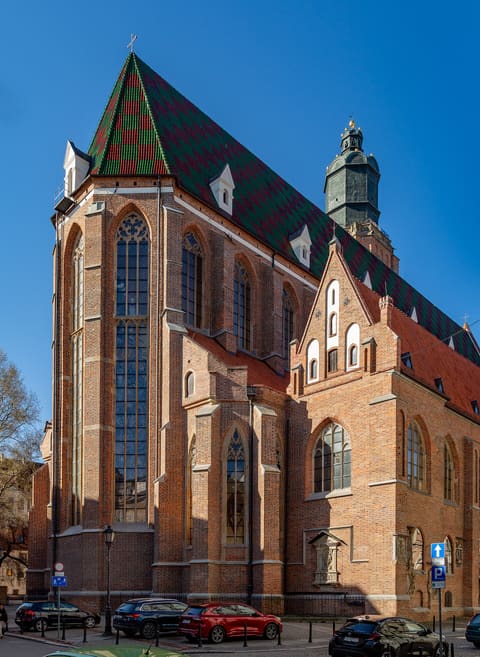
Pko, Wikimedia Commons, CC BY-SA 4.0 St Elizabeth’s
Church of St Elizabeth
A three-aisled Gothic basilica, built in the fourteenth century by the Market Square. Its tower, finished in the mid-fifteenth century, now measures more than 90 metres according to the parish. Burned in 1975 and 1976; Pope John Paul II rededicated the church on 31 May 1997.
-
Grotowski Institute
Instytut im. Jerzego Grotowskiego
At Rynek-Ratusz 27, behind the Town Hall, is the building Jerzy Grotowski's theatre made its home in January 1965. The Grotowski Institute, named after him, has its seat there now.
-
Movie Gate
under Plac Solny
Under the square, in a former shelter, is a museum of costumes, props and pieces of film sets from well-known films. The way in is at Plac Solny 10a.
Also on the square, not pinned
-
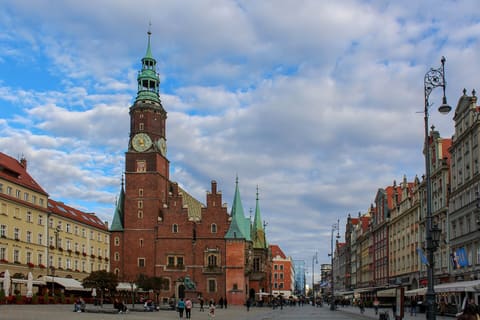
Szczecinolog, Wikimedia Commons, CC BY-SA 4.0 The Market Square
Rynek
The centre of the medieval town, laid out after the destruction of 1241 as the middle of a regular grid. The Town Hall stands not on the edge but in the middle, among a block of other buildings, with the houses of the burghers around the outside.
-
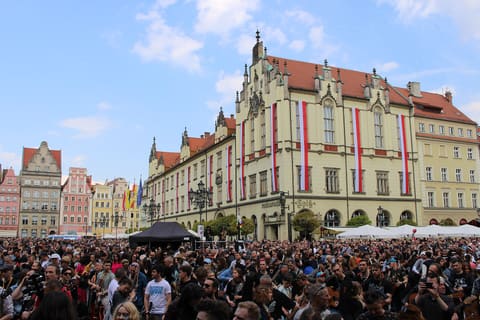
Nietoksyczny, Wikimedia Commons, CC BY-SA 4.0 The guitar record
Gitarowy Rekord Świata
On 1 May the square fills with guitarists playing Jimi Hendrix’s “Hey Joe” together. It started on 10 May 2003, when 588 of them turned up, and the most who have ever played it is 8,122, in 2025.
Not pinned: the page does not say where on the square it is held.
-
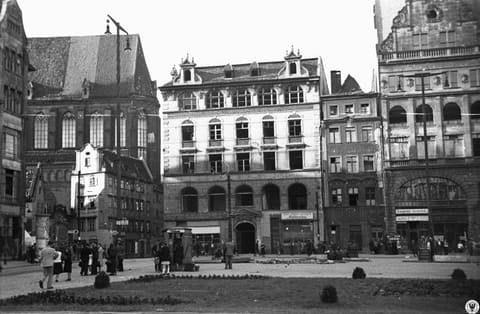
Fot. Bogdan Celichowski, Wikimedia Commons, CC BY 3.0 Rebuilt after 1945
The Rynek in 1947
The buildings around the square were damaged in 1945 and rebuilt afterwards.
The square in photographs

Seeing it
The Town Hall has its own page, Town Hall, and the rest of the landmarks are listed on the landmarks page.
The main tourist information centre is on the square, at Rynek 14. It and the other points are listed under tourist information on the getting around page.