
Świdnica
A town in Lower Silesia with a wooden Church of Peace on the UNESCO World Heritage List, a Gothic cathedral and a market square, reached from Wrocław Główny by regional train.
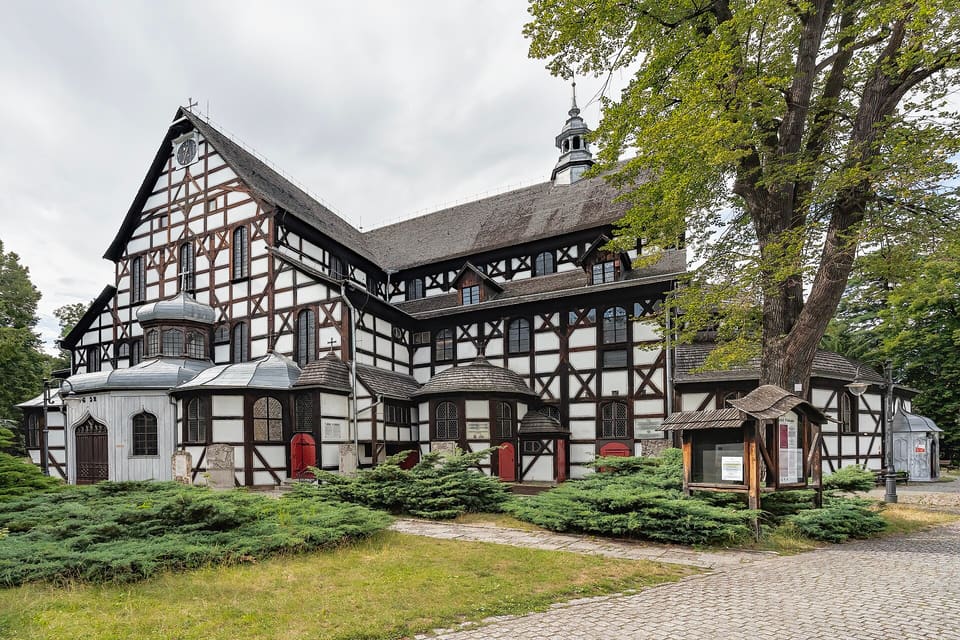
Krzysztof Popławski Wikimedia Commons CC BY 4.0
What it is
Świdnica is a town in Lower Silesia. Centuries ago it was the capital of the Piast duchy of Świdnica and Jawor. Its churches and its market square are what a visitor goes for.
The Church of Peace
The Church of Peace (Kościół Pokoju) is the Evangelical church of the Holy Trinity. It is a wooden, timber-framed building on the plan of a Greek cross, built after the Thirty Years’ War with the permission of the Catholic Habsburg emperor, and it dates from 1657.
Together with the Church of Peace in Jawor it was inscribed on the UNESCO World Heritage List in 2001.
The emperor’s permission came with conditions meant to make the building hard: it had to be built of wood, clay and straw, not stone or brick. The first service was held in 1657. Inside, the ground floor and four storeys of galleries hold up to 7,500 people. The interior is Baroque: an 18th-century carved altar with a relief of the Last Supper above the altar stone, an 18th-century pulpit with figures of Faith, Hope and Love, and a 17th-century organ. The oak came from the family of Count Johann Heinrich von Hochberg, whose box faces the pulpit.
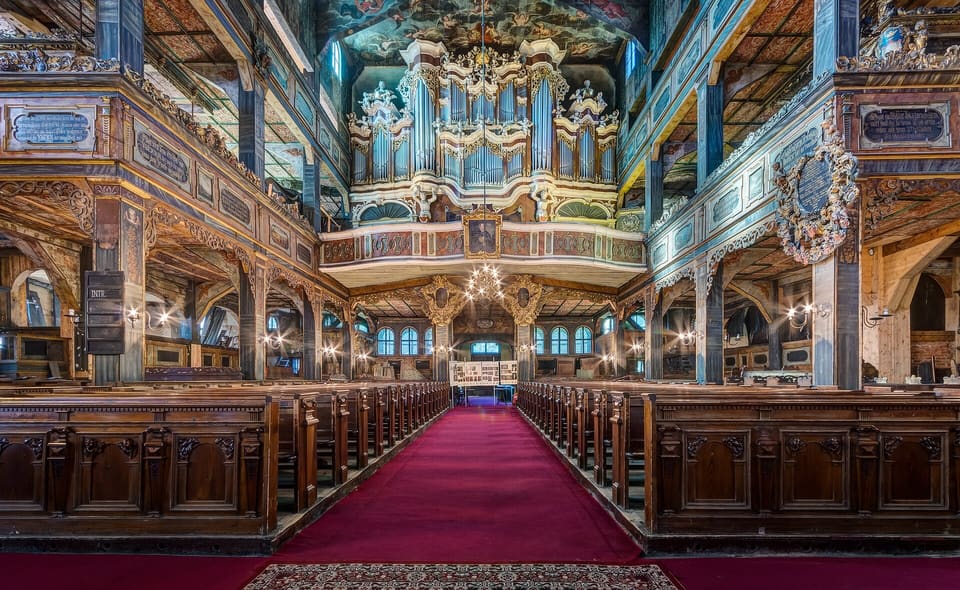
The nave, looking towards the organ.
Jar.ciurus Wikimedia Commons CC BY-SA 3.0 pl
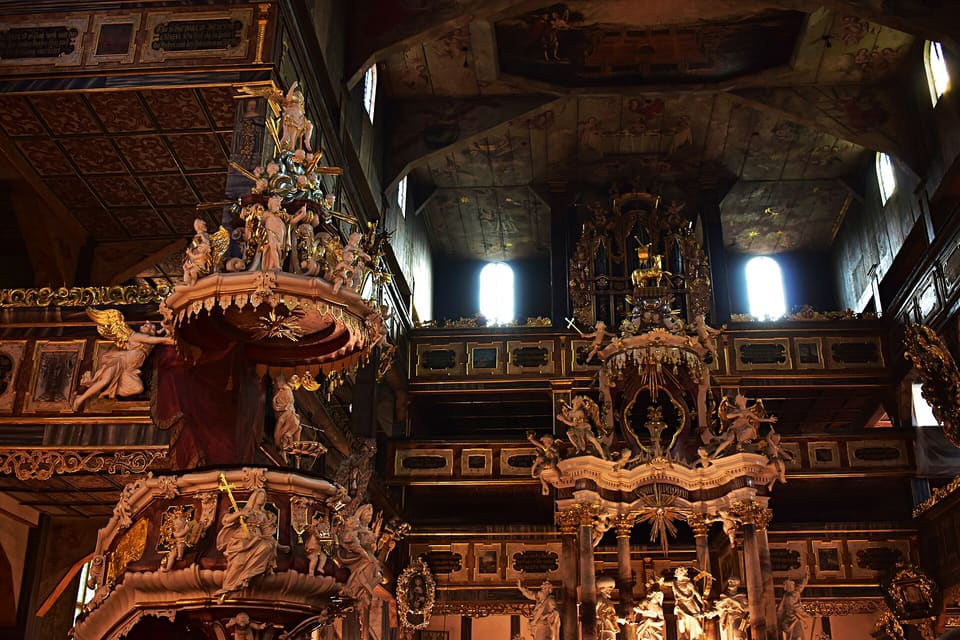
The pulpit, with the altar beyond it.
Fotozetka Wikimedia Commons CC BY 4.0
The cathedral and the Rynek
The Gothic cathedral of St Stanislaus and St Wenceslaus was begun in 1330.
It has been a cathedral since 2004, when Świdnica became the seat of a new diocese, and its tower stands over the town. In 2017 it was named a Monument of History (Pomnik historii).
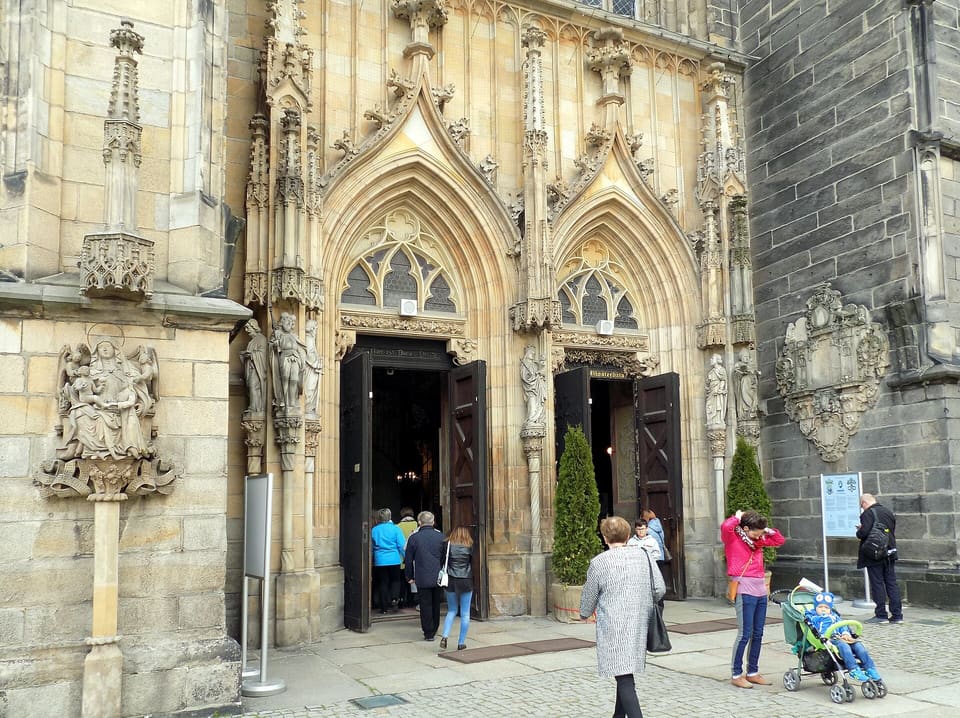
The cathedral’s west doorways.
Paweł Schmidt Wikimedia Commons CC BY 3.0
The market square (Rynek) has a town hall in the middle and richly decorated townhouses around it.
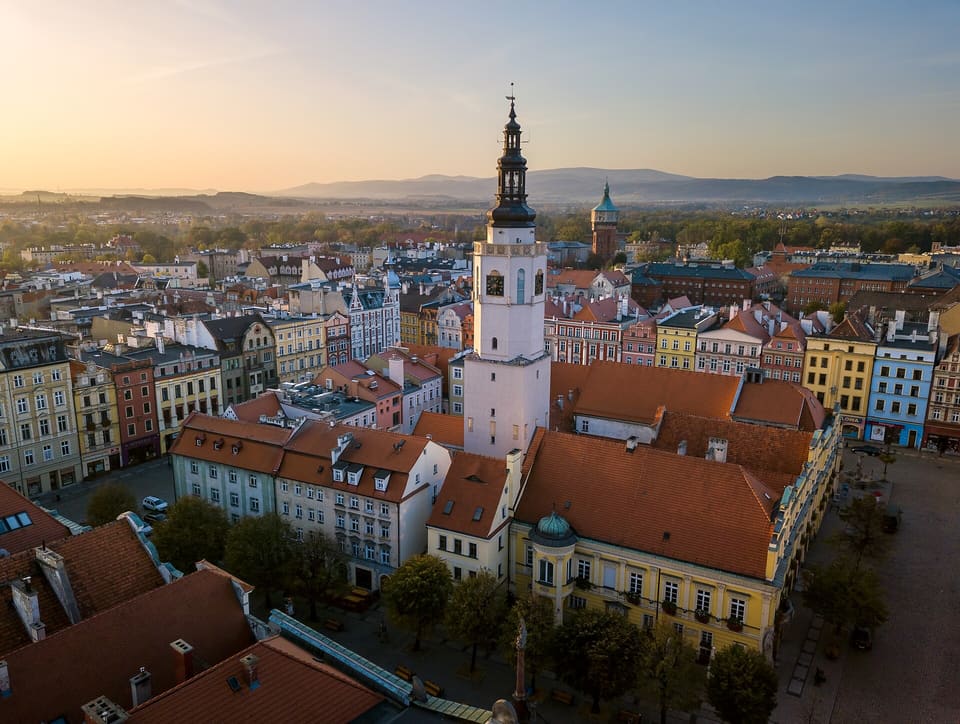
The town hall in the middle of the market square.
Kateryna Baiduzha Wikimedia Commons CC BY-SA 4.0
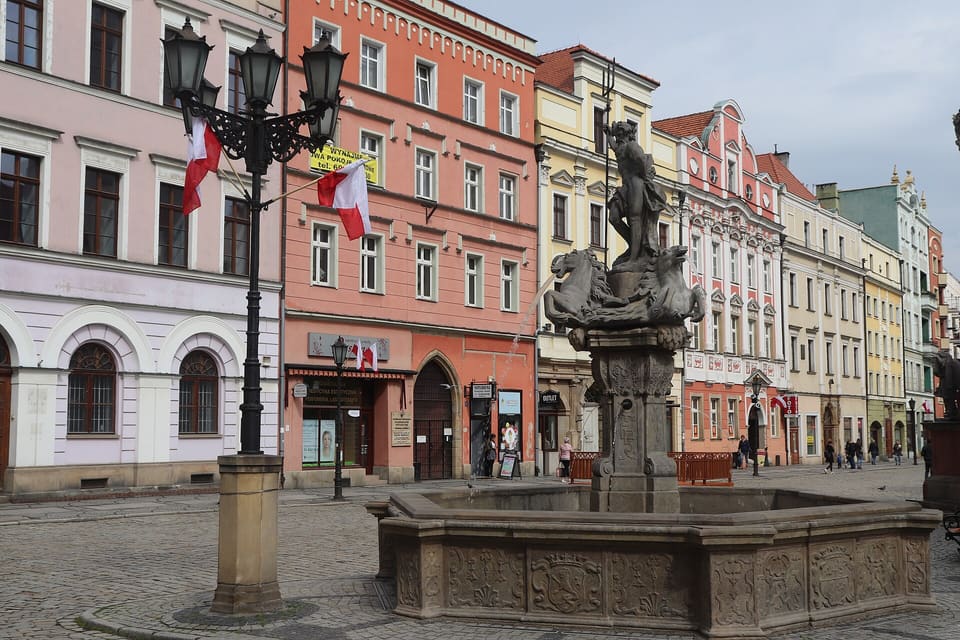
A fountain on the market square.
Andrzej Otrębski Wikimedia Commons CC BY-SA 4.0
A day on foot: from the station to the Church of Peace
The map follows one day out: the Koleje Dolnośląskie train from Wrocław Główny through Sobótka to Świdnica Miasto, then on foot from the station to the market square and the town hall, to the cathedral, and to the Church of Peace. It plays by itself; the stops are listed under it.
Map data © OpenStreetMap contributors, under the ODbL: the rail line, roads, river, streets, paths, buildings, water and woods. The walk is routed with OSRM on OpenStreetMap data.
- Świdnica Miasto station
- Market square and town hall
- Cathedral
- Church of Peace
Getting there from Wrocław
Koleje Dolnośląskie (KD), the regional railway, runs direct trains from Wrocław Główny to Świdnica, to the stations Świdnica Przedmieście and Świdnica Miasto. One route goes through Sobótka, the town at the foot of Ślęża, so the mountain and the town lie on the same line. More on regional trains is on the trains page.
Links
- Koleje Dolnośląskie: timetables (in Polish) kolejedolnoslaskie.pl
- The Church of Peace: visiting, from the parish (in English) kosciolpokoju.pl
- The cathedral: visiting, from the parish (in Polish) katedra.swidnica.pl
- UNESCO: the 2001 decision to inscribe the Churches of Peace in Jawor and Świdnica (in English) whc.unesco.org