
Landmark
Ossolineum
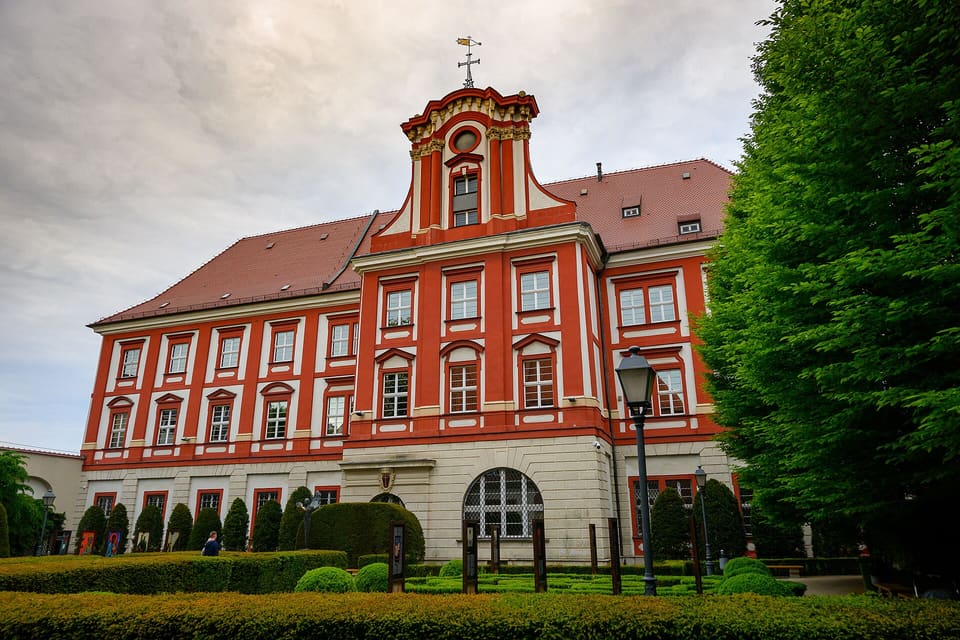
A national library and institute founded in 1817, in the baroque buildings of a former monastery and hospital on ulica Szewska, with a garden in its courtyard.
Daniel.zolopa Wikimedia Commons CC BY 4.0

What it is
The Ossolineum is the Zakład Narodowy im. Ossolińskich, the Ossoliński National Institute. It was founded for the Polish Nation in 1817 by Józef Maksymilian Ossoliński, and stood in Lwów, now Lviv in Ukraine.
After the Second World War the city was no longer in Poland. The institute was re-established in Wrocław in 1946, and the war-damaged buildings on ulica Szewska were rebuilt for it in 1946 and 1947.
The buildings
They were the monastery and hospital of the Knights of the Cross with the Red Star, a hospital order. Between 1690 and 1710 the medieval buildings were replaced by the baroque ones that stand today.
The monastery was secularised in 1811, and the building then held a Catholic gymnasium, known in German as the Matthiasgymnasium, until the war.
The garden
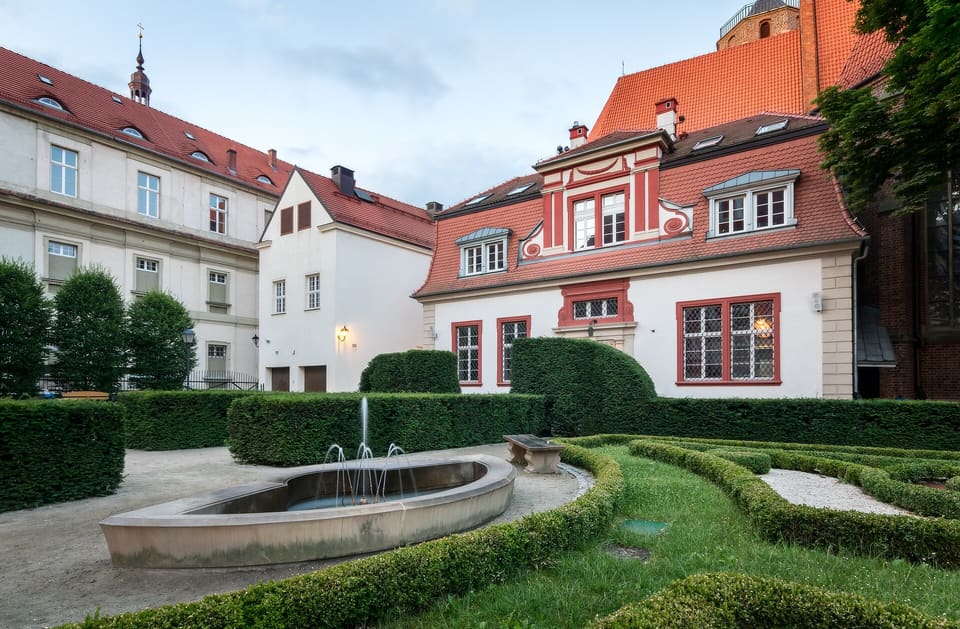
A baroque garden is laid out in the courtyard, and it is open to the public. It lies on the walk between the Rynek and Ostrów Tumski, and few people passing on the street know it is there.
In it are a sandstone fountain, garden quarters in clipped ornament, a monument to the victims of the First World War, and a monument to Angelus Silesius, the baroque poet and mystic, made by Ewa Rossano and unveiled in October 2007.
Jar.ciurus Wikimedia Commons CC BY-SA 3.0 pl

Seeing it
The building is at ulica Szewska 37 and holds the Museum of the Princes Lubomirski, most of the library and the publishing house. The Pan Tadeusz Museum belongs to the same institute but is a separate building, at Rynek 6 on the Rynek.