Landmark
Copernicus Park
Park Kopernika: a strip of park on the line of the old city moat, between Świdnicka Street and Księdza Piotra Skargi Street, with the puppet theatre at one end and a monument to Copernicus at the other.
Grzegorz Browarski Wikimedia Commons CC BY-SA 4.0
Four names for one park
Google Maps calls it Nicolaus Copernicus Park. The city's parks authority calls it the Ogród Staromiejski, the Old Town Garden, and lists park Mikołaja Kopernika among its other names. Wrocław's own news pages call it park Staromiejski. From 1967 it was named after Hanka Sawicka, and before any of that it was the Zwingergarten. They are all the same green strip, and which name you were given depends on which map you read.
The ground is older than the park. It is the międzymurze, the space between the city's two walls, where the marksmen's brotherhood had its shooting range. In 1767 Carl Gotthard Langhans built them a classicist clubhouse here — the Zwinger — and the garden beside it was laid out and enlarged between 1768 and 1770. The long promenade that runs through it, along the moat, came later, between 1813 and 1816, when the fortifications were being taken down.
It is part of the historic centre of Wrocław, which was declared a Monument of History in 1994. One tree in it is a natural monument in its own right: a London plane.
The puppet theatre
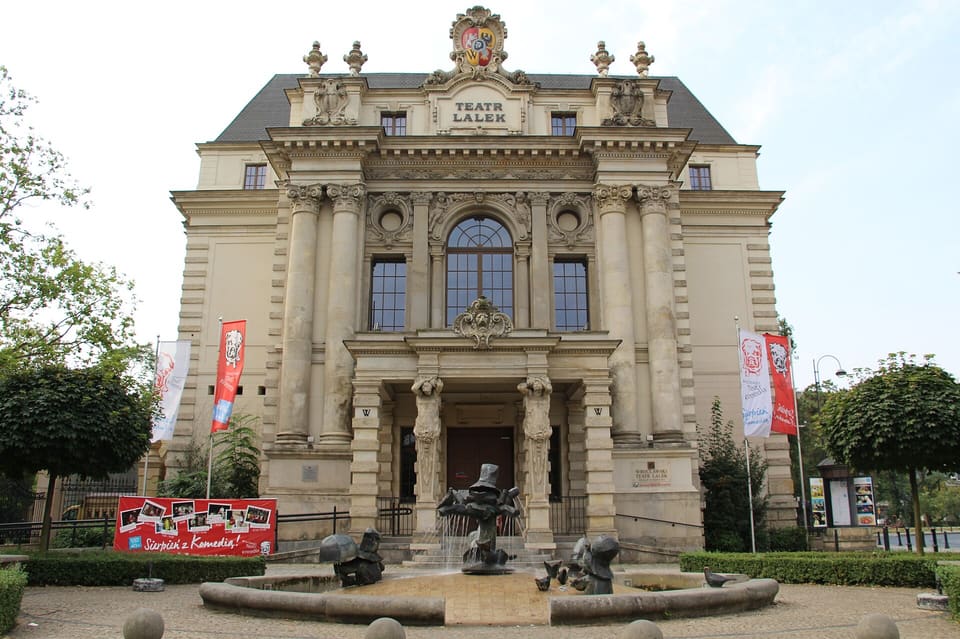
The Wrocław Puppet Theatre (Wrocławski Teatr Lalek) stands at 4 Teatralny Square, beside the park rather than in it; a broad terrace on its east side is what joins the two. The building went up in 1892–1894 as the Resursa Kupiecka, the clubhouse of the association of Christian merchants: club rooms on the ground floor, a ballroom and concert hall above. Langhans' Zwinger had stood on the site until 1892, when it was demolished to widen the street and lay out the square.
Who designed it depends on whom you ask. The national heritage register credits Eduard Blümner; the theatre's own history credits Paul Kieschke and Richard Bielenberg, the winners of the competition. This page does not pick between them.
The company is older than its tenancy. It was founded on 18 October 1946 by Zenon and Elżbieta Kalinowicz, who had learned puppetry in the Soviet Union during the war, and it opened on a stage in Rzeźnicza Street. It moved into this building in 1965 and shared it with the Society of Polish-Soviet Friendship; the city gave the theatre the whole of it only in 1999. In 2026 it is eighty years old.
It is not only a children's theatre, and that is the interesting part. From 1967 it ran a small stage for adults for three decades, on which Wiesław Hejno staged Kafka's The Trial, Witkacy's Gyubal Wahazar and Goethe's Faust; the first two took first prize at the international puppet festival in Zagreb, in 1985 and 1987. Poland's puppetry school grew out of the same theatre: a training course started here in 1967 became the puppetry faculty of the Kraków theatre academy, in Wrocław, in 1972.
Fred Romero from Paris, France Wikimedia Commons CC BY 2.0
The Copernicus monument
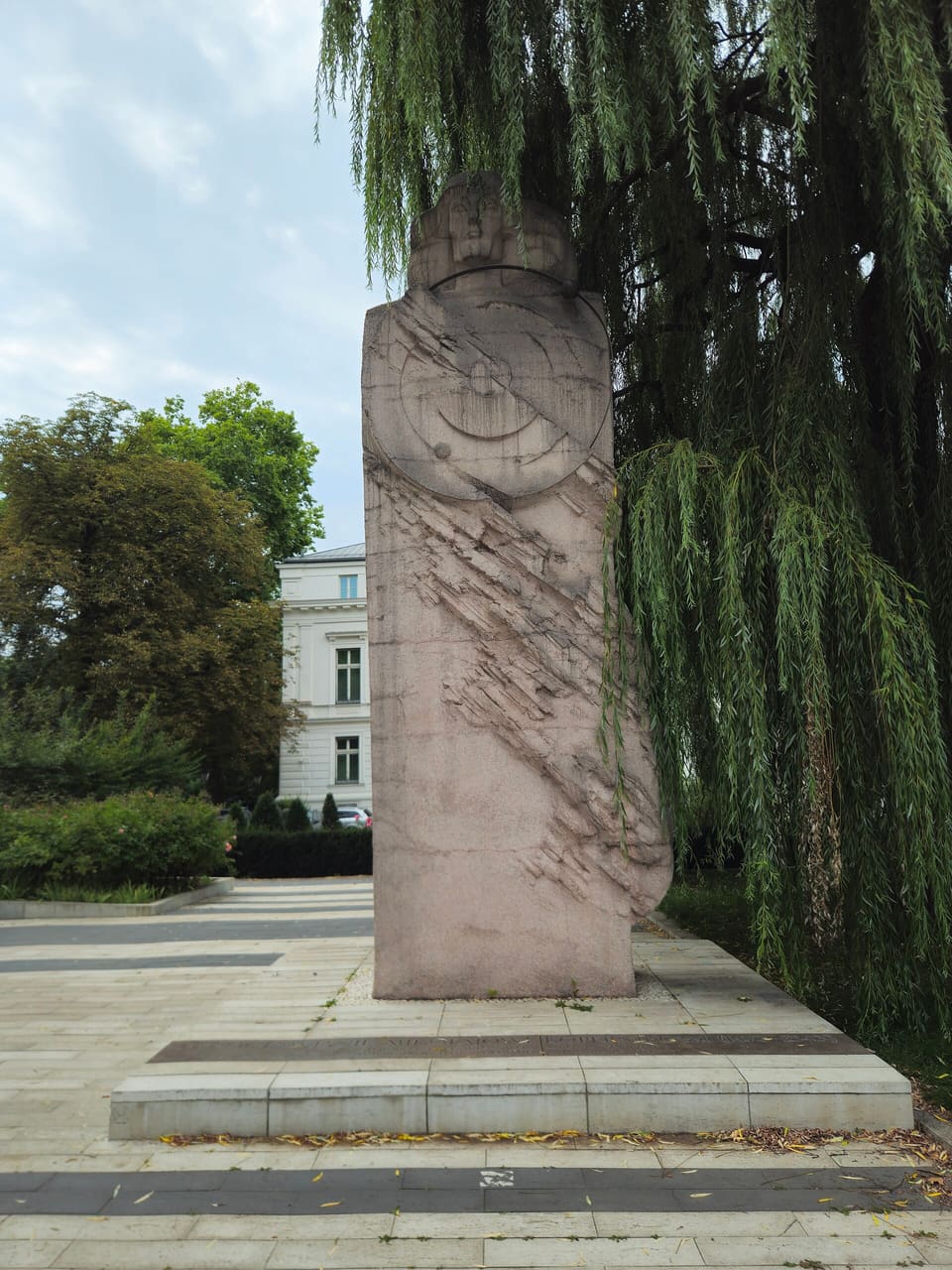
It stands on the paved square just outside the park's eastern entrance, where Wierzbowa Street meets Księdza Piotra Skargi Street — not in the park, though the park is named after him. It is not a conventional statue: a tapering stele carved with the circles of a heliocentric system, with a stylised head of the astronomer on top. Leon Podsiadły made it, and it was put up in 1974 for the five hundredth anniversary of Copernicus' birth, on the initiative of the Society of Friends of Wrocław and the Society of Friends of Astronomy.
Grzegorz Browarski Wikimedia Commons CC BY-SA 4.0
In the garden
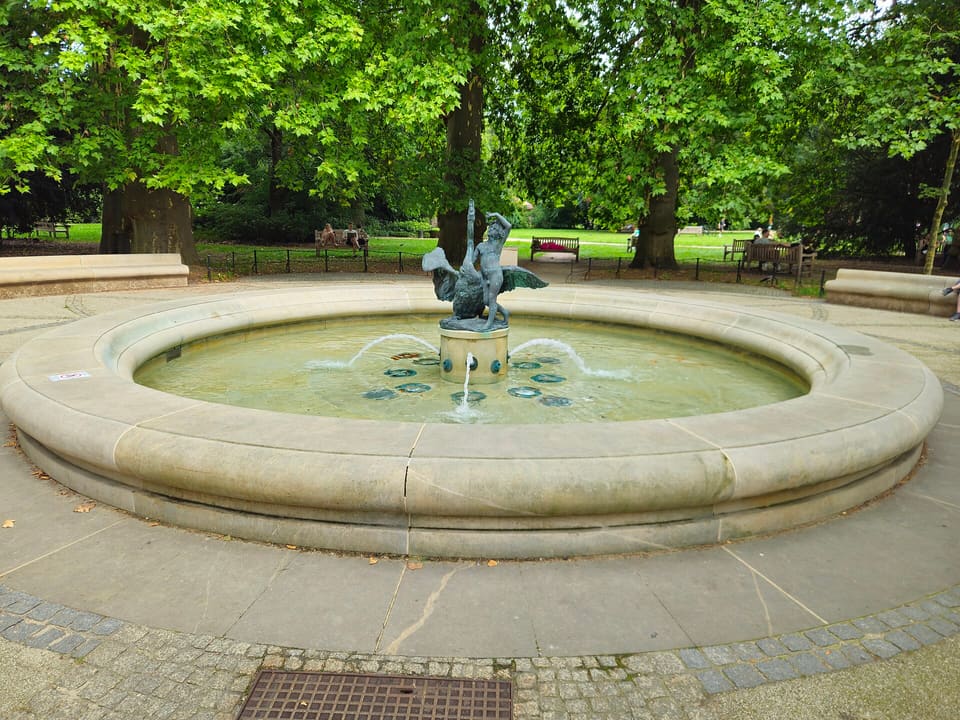
The fenced garden at the theatre end holds the fountain in the first photograph above, with Cupid riding Pegasus over it, and a fountain of a boy with a swan that is a reconstruction. There is a playground, an aviary, the theatre's summer stage, and a carousel of the old French kind, with wooden horses and gondolas, which runs in the warm months.
The garden was restored in 2010 in the manner of a pre-war municipal garden, and fenced again at the same time. The parks authority records that the fence caused a good deal of argument and that nobody argues about it now.
Seeing it
The park runs between Świdnicka Street and Księdza Piotra Skargi Street, with Teatralna Street and Teatralny Square along its north side and the moat along its south. The Renoma end of Świdnicka, with the Bolesław Chrobry monument and the Pogodynka, is at the western corner.